11.7
CiteScore
7.9
Impact Factor

2026 Vol. 53, No. 6

Review
The crosstalk between nitrogen utilization and abiotic stress tolerance in rice
Qing Li, Jiajia Liu, Qian Qian, Zhenyu Gao
2026, 53(6): 976-989. doi: 10.1016/j.jgg.2026.01.010
Abstract (112)
Abstract:
Improving nitrogen use efficiency (NUE) in rice is crucial for sustainable agriculture, yet remains a significant challenge due to its complex polygenic and environmental regulation. Although multiple NUE-associated genes have been identified, their intricate regulatory networks are poorly understood, especially under abiotic stresses such as drought, salinity, and extreme temperatures. This review systematically summarizes the genetic basis of NUE in rice, covering key genes involved in nitrogen uptake, translocation, assimilation, and remobilization. It further explores the crosstalk between nitrogen utilization and abiotic stress tolerance, highlighting integrative signaling nodes such as the dual nitrate/ABA receptor OsNRT1.1B. Finally, a comprehensive strategy is proposed to develop elite rice varieties with high NUE and multi-stress resilience, supporting the advancement of resource-efficient and climate-smart agriculture.
Design and engineering of photorespiratory bypasses in plants
Liying Zhang, Kaining Jin, Zhiguo Zhang, Tiegang Lu
2026, 53(6): 990-999. doi: 10.1016/j.jgg.2026.02.007
Abstract (174)
Abstract:
Photorespiration is an essential metabolic process in C3 plants, yet it imposes significant carbon losses of up to 30% or more. Synthetic biology has recently enabled the engineering of diverse photorespiratory bypasses to overcome this limitation. In this review, we categorize these bypasses into three major types based on glycolate carbon retention and CO2 release. The first are chloroplast-localized carbon-releasing bypasses, which shift CO2 release from mitochondria to chloroplasts, thereby establishing a localized CO2-concentrating mechanism around Rubisco. The second are carbon-neutral bypasses, which conserve carbon during glycolate metabolism, thereby avoiding net carbon loss and often coupling bypasses with nitrogen assimilation. The third are carbon-positive bypasses, which not only minimize carbon loss but also achieve net carbon gain. We also emphasize some bypasses that redirect glycolate flow toward the production of more valuable metabolites, such as amino acids and organic acids. These strategies reveal that by reprogramming glycolate metabolism, it is possible to overcome the inherent photorespiratory limitations and increase photosynthetic efficiency in C3 crops. Overall, this review offers an overview of current genetic strategies for suppressing photorespiration in model plants and crops and guides future optimization and rational design of photorespiratory bypasses.
Decoding heterosis in rice: from classical theories to modern omics insights
Wen Huang, Tianhao Zhou, Ying Yang, Zhiwei Fu, Haodong Yan, Ran Ouyang, Ahmed Khatab, Jiayang Li, Yongzhong Xing
2026, 53(6): 1000-1011. doi: 10.1016/j.jgg.2026.02.011
Abstract (154)
Abstract:
Heterosis, commonly referred to as hybrid vigor, describes the biological phenomenon by which F1 hybrids outperform their parents. The exploitation of rice heterosis has made a great contribution to yield improvements and global food security. However, a unified molecular theory explaining heterosis remains elusive. This review consolidates recent advances in rice heterosis research, focusing on genetic and multi-omics. We discuss the contribution of key genes, non-additive gene expression patterns, and metabolic changes that underpin hybrid performance. The genomic, transcriptomic, epigenetic, and metabolomic evidence supporting dominance, overdominance, and epistasis hypotheses for heterosis are highlighted and integrated. The collective evidence suggests that heterosis is not governed by a single universal mechanism but is a complex consequence of synergistic interactions from sequence variation to regulatory networks across multiple omics. We also highlight emerging applications of artificial intelligence (AI) driven prediction in the breeding of next-generation super-hybrid rice. We propose that key points of future heterosis research should extend beyond static omics snapshots to dynamic, developmental, and metabolic pathways related to yield formation, such as energy metabolism, which decode the ontogenetic basis and the mechanistic understanding of heterosis. Progress in this area will accelerate the breeding of high-yielding, resilient hybrid rice cultivars.

Improving root–soil adaptability by modifying root system architecture in rice
Junxiang Zhang, Yali Xiong, Guoqiang Huang
2026, 53(6): 1012-1022. doi: 10.1016/j.jgg.2026.02.023
Abstract (184)
Abstract:
Plant root systems serve essential roles in soil anchorage, water uptake, and nutrient acquisition. Root system architecture (RSA) refers to the spatial arrangement of the root system in the soil, reflecting the geometric arrangement of root axes and the structure, morphology, and anatomy of root branches. Rice (Oryza sativa) is a key cereal crop with a hierarchically organized root system that consists of embryonically derived primary roots and postembryonic crown roots, together with their associated lateral roots and root hairs, each of which exhibits specialized structural modifications. This review systematically examines key architectural components of the rice root system; the stress-responsive RSA traits that contribute to abiotic stress resilience and/or tolerance; and precise strategic approaches for the development of optimized root ideotypes through integrated phenotyping and genomic technologies.
Design strategies for enhanced sustainable green revolution productivity in rice
Shuoxun Wang, Jie Hu, Wenzhen Song, Qiaoling Zhang, Chenchen Wu, Jiangyi Zhou, Lindong Yang, Yunzhe Wu, Yafeng Ye, Weishu Fan, Xiangdong Fu, Kun Wu
2026, 53(6): 959-975. doi: 10.1016/j.jgg.2025.06.004
Abstract (221)
Abstract:
Modern agriculture relies heavily on resource-intensive and environmentally harmful inputs, while the increasing global population and decreasing arable land demand new strategies to improve sustainable productivity of cereal crops, particularly reducing inorganic nitrogen fertilizer use while simultaneously increasing photosynthesis and grain yield in rice. To improve rice productivity, it is essential to improve photosynthetic nitrogen assimilation and optimize the translocation of carbon and nitrogen products from source to sink tissues. In this review, we first summarize recent advances in the genetic basis for improving grain yield by enhancing photosynthetic carbon and nitrogen assimilation. We then discuss progress in modulating the source-sink relationships to achieve higher yield and improved harvest index. Finally, we explore the necessary optimizations for adapting rice to high-density planting. These advancements are driving the development of sustainable green revolution varieties through the rational design of multi-gene pyramids and artificial intelligence-driven protein engineering.
Original Research
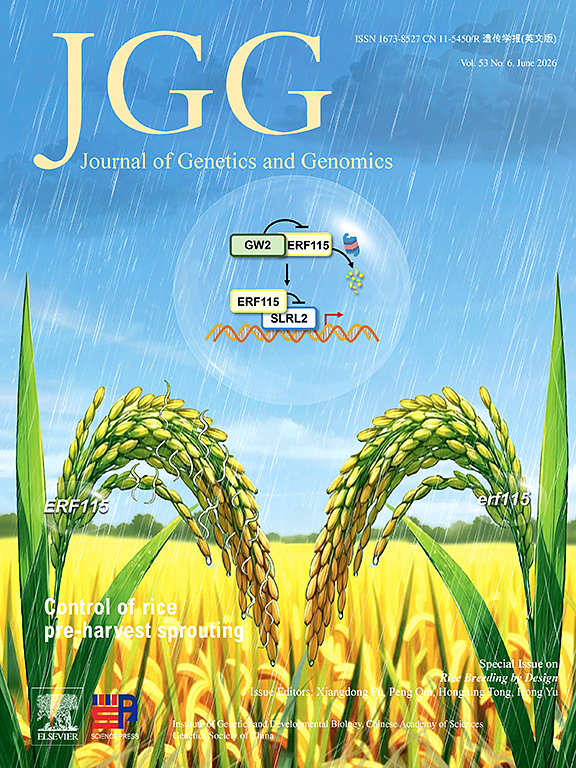
The GW2-ERF115-SLRL2 module regulates seed dormancy in rice
Jin-Dong Wang, Li-Jun Kan, Wu-Jian Shi, Jia-Wen Yu, Yu Zhou, Zhen-Long Yin, Chang-Quan Zhang, Xiao-Lei Fan, Dong-Sheng Zhao, Li-Chun Huang, Lin Zhang, Qiao-Quan Liu, Qian-Feng Li
2026, 53(6): 1023-1033. doi: 10.1016/j.jgg.2026.03.022
Abstract (202)
Abstract:
Pre-harvest sprouting (PHS), caused by weak seed dormancy and environmental stimuli, leads to significant losses in both crop yield and grain quality. Breeding crop cultivars with enhanced PHS resistance represents a promising strategy to address this challenge. However, limited useful genetic resources has hindered the progress in rice molecular breeding. Through screening of a rice mutant library, we identify the ethylene response factor115 (erf115) mutant, which exhibits enhanced PHS resistance. Genetic analysis reveals that ERF115 functions as a negative regulator of seed dormancy. Mechanistic assays show that the E3 ubiquitin-protein ligase Grain Width 2 (GW2) interacts with and ubiquitinates ERF115, thereby promoting its proteasomal degradation. Accordingly, gw2 mutants display increased PHS susceptibility. ERF115 also interacts with the transcription factor SLR1-like 2 (SLRL2) and represses its transcriptional activation activity, consequently reducing the expression of the dormancy gene Mother of FT and TFL1 like 2 (MFT2). Haplotype analysis identifies three major ERF115 haplotypes (HapI–HapIII), among which ERF115Hapl represents an elite allele associated with reduced PHS. Collectively, our findings reveal a GW2-ERF115-SLRL2 regulatory module that integrates ubiquitin-mediated regulation and hormone signaling to fine-tune rice seed dormancy, providing valuable genetic resources for breeding PHS-resistant rice varieties.
ZFP151 enhances drought tolerance in rice through direct activation of NCED4 expression
Kai Huang, Xiujie Liu, Wenzhu Jiang, Jingtong Zhang, Wenjun Zhu, Xinran Peng, Juntao Wang, Xiaojun Ma, Xinglin Du, Bin Hu, Chengcai Chu
2026, 53(6): 1034-1044. doi: 10.1016/j.jgg.2026.02.022
Abstract (173)
Abstract:
Drought is a devastating abiotic stress that severely compromises global rice production. Despite decades of extensive research, the molecular mechanisms underlying rice drought tolerance remain largely elusive. Here, we characterize a Cys2/His2 (C2H2)-type zinc finger protein, ZFP151, as a positive transcription factor of rice drought tolerance. Mechanistically, ZFP151 directly binds to the promoter of NCED4, a rate-limiting gene in the abscisic acid (ABA) biosynthetic pathway and transcriptionally activates its expression. Through haplotype analysis of natural rice accessions, we identify five major ZFP151 haplotypes (Hap0–Hap4), among which ZFP151Hap1 is determined as the elite allele. This allele correlates with higher NCED4 expression and elevated ABA levels under drought conditions. Introgression of ZFP151Hap1, the elite allele, into the japonica cultivar Koshihikari, which carries the ZFP151Hap0 allele, significantly improves its drought tolerance. Collectively, our findings uncover the regulatory role of ZFP151 in ABA-mediated drought response and underscores its potential as a target for genetic improvement of drought-tolerant rice varieties.
Natural variation of OsGATA16 contributes to differential immunity against Magnaporthe oryzae in rice
Hongjia Zhang, Zhao Li, Hong Li, Yan Liu, Baoshuai Zhang, Sudi Li, Lei Zhang, Jiawei Zhao, Weiwei Zou, Yuxin Tu, Bin Hu, Chengcai Chu, Xinglin Du, Wenzhu Jiang, Soon-Wook Kwon, Zhihua Zhang
2026, 53(6): 1045-1057. doi: 10.1016/j.jgg.2026.04.007
Abstract:
Rice blast, caused by the fungal pathogen Magnaporthe oryzae, constitutes a critical threat to global rice production. Leveraging functional genes from germplasm resources to breed resistant varieties remains the most effective and sustainable strategy for blast control. Here, we identify a GATA transcription factor, OsGATA16, as a candidate regulator of blast resistance by genome-wide association study (GWAS) using a diverse rice germplasm panel. Functional analysis shows that OsGATA16 overexpression significantly reduces blast resistance, whereas knockout lines exhibit enhanced resistance, establishing OsGATA16 as a negative regulator of rice immunity. Transcriptome, qRT-PCR, dual-luciferase, and DAP-seq assays reveal that OsGATA16 directly represses diterpenoid biosynthetic genes. UPLC-MS/MS reveals increased accumulation of pimarane-type diterpenoids in osgata16 mutants. Further analysis indicates that the key pimarane-type diterpenoid abietic acid promotes blast resistance but compromises cold tolerance. Given the known role of OsGATA16 in cold tolerance, haplotype analysis of 137 core-collection rice accessions uncovers a trade-off between blast resistance and cold tolerance. The japonica-dominant Hap1, featuring key residues Val292 and Gly333, shows stronger transcriptional repression activity than indica Hap2, with population genetics supporting divergent allele selection. Collectively, OsGATA16 negatively regulates blast resistance by repressing pimarane-type diterpenoid biosynthesis, serving as a valuable target for breeding dual stress-resilient rice.
An integrative gene regulatory network identifies transcriptional hubs governing the photosynthetic apparatus in rice
Ming-Ju Lyu, Faming Chen, Xiaoya Li, Aidi Luo, Qingfeng Song, Yangmeihui Li, Xiaoyu Tu, Changsong Zou, Xin-Guang Zhu
2026, 53(6): 1058-1073. doi: 10.1016/j.jgg.2026.03.024
Abstract (219)
Abstract:
Photosynthesis fuels crop growth and yield, yet the regulatory networks coordinating photosynthetic gene expression with carbon allocation remain incompletely understood. Here, we construct a gene regulatory network (GRN) for rice photosynthesis by integrating time-resolved RNA-seq, ATAC-seq, and promoter cis-element analyses. We identify nine hub transcription factors (TFs), four of which (OsPIL13, OsbZIP72, OsCGA1, and OsGLK1) exhibit strong leaf-specific, light-inducible expression patterns. Overexpression of OsPIL13, OsbZIP72, or OsGLK1 using photosynthetic tissue-specific promoters significantly enhanced the light-saturated photosynthetic rate (Asat) across developmental stages, with OsPIL13 overexpression increasing Asat by up to 57% during grain filling. While several hub TFs boosted photosynthetic capacity, consistent improvements in biomass and grain yield under field conditions were rare. Notably, OsGLK1 overexpression confers stable yield gains across multiple growing seasons. Comparative transcriptomic analysis indicates that OsGLK1 also upregulates genes involved in brassinosteroid biosynthesis and sugar and lipid transporter genes, potentially linking photosynthetic output to growth and resource allocation. Collectively, our findings indicate that enhancing photosynthesis alone is insufficient to guarantee yield improvement; rather, the coordinated regulation of photosynthetic capacity and downstream carbon utilization is essential for sustainable productivity gains in rice.
Rational design for rice eating and cooking quality via combination of the Waxy and ALK haplotypes
Yuankang Cai, Qinglu Zhang, Yidan Ouyang, Jinghua Xiao, Yuqing He, Qifa Zhang, Xu Li
2026, 53(6): 1074-1085. doi: 10.1016/j.jgg.2026.03.025
Abstract (168)
Abstract:
Improving rice eating and cooking quality (ECQ) through designed breeding requires a precise understanding of the functions and interactions of key gene haplotypes. Waxy and ALK are two major genes regulating ECQ, but how different combinations of their alleles interact to affect yield and quality traits remains largely unexplored. Here, we construct a set of 30 near-isogenic lines (NILs) from the elite cultivar Huanghuazhan, systematically combining 6 Waxy and 5 ALK alleles, including a recombinant-derived functional allele, ALKe, identified in this study. Under non-extreme high temperature conditions, Waxy is associated with grain yield primarily via seed setting rate and thousand-kernel weight in our NIL populations, whereas ALK has no significant effect on yield. Compared with the Wxb-ALKb combination, the Wxb-ALKe combination improves the ECQ without compromising yield. Starch structural analysis reveals that Waxy controls chalkiness and head rice yield (HRY) via apparent amylose content, whereas ALK affects chalkiness by altering amylopectin chain-length distribution. Notably, high temperature during grain filling intensifies chalkiness and reduces HRY, particularly in the ALKc lines. These findings provide genetic resources and facilitate the design breeding of rice varieties that meet diverse consumer preferences.
Engineering a transport-facilitating molecular module to improve seed-setting rate and yield in rice
Anyao Huang, Shuofan Wu, Bodi Li, Limin Wang, Guohui Zhu, Taiyu Chen, Zhisheng Zhang, Xinxiang Peng
2026, 53(6): 1086-1096. doi: 10.1016/j.jgg.2026.03.005
Abstract (163)
Abstract:
Rice yield is fundamentally governed by source–sink dynamics, in which the efficient translocation of non-structural carbohydrates (NSC) plays a pivotal role. Our previously developed GCGT photorespiratory bypass rice, while possessing high photosynthetic capacity, exhibits disordered sugar metabolism that impedes photoassimilate translocation and leads to a reduced seed-setting rate. To tackle this bottleneck, we construct a transport-facilitating molecular module, RSS, by integrating α-amylase (OsRAmy2A), sucrose phosphate synthase (OsSPS8), and sucrose transporter (OsSUT1) genes. In field trials, RSS rice plants (in both ZH11 and GCGT backgrounds) display significant increases in seed-setting rate, harvest index (HI), and grain yield. Crucially, the RSS module redirects photoassimilate partitioning, reducing NSC accumulation in vegetative tissues while enhancing allocation to panicles. This strategy not only improves yield in wild-type plants but also effectively ameliorates the sugar metabolism defects and photoassimilate stagnation in high-photosynthetic-efficient GCGT rice, substantially restoring the seed-setting rate. Taken together, our results demonstrate that the transport-facilitating molecular module RSS can significantly improve seed-setting rate and yield in rice, offering an effective strategy to unlock yield potential for rice.
Palea and grain shrunken encoding OsMADS15 determines palea identity to affect rice grain yield and quality
Di Jin, Chao-Yue Yang, Xiao Liu, Jin-Song Lan, Tao Jiang, Hao Chen, Jia-Ying Zhang, Yu-Tong Jiang, Bo-Ran Peng, Liu-Jing Wang, Guang-Hua He, Nan Wang, Yun-Feng Li, Hui Zhuang
2026, 53(6): 1097-1111. doi: 10.1016/j.jgg.2026.04.019
Abstract (112)
Abstract:
The hull, composed of the lemma and palea, defines rice grain morphology and influences endosperm filling and quality. However, how palea development affects grain filling and quality remains poorly understood. Here, we identify a rice mutant, palea and grain shrunken 1 (pgs1), which exhibits a markedly reduced palea and elongated sterile lemmas. MutMap-based cloning reveals that PGS1 encodes the MADS-box transcription factor OsMADS15. The pgs1 mutant shows smaller but denser grains with substantially reduced chalkiness, and the expression of several palea identity genes, including G1, OsMADS1, and SL1, is significantly decreased. PGS1 is expressed in multiple floral organs, localizes to the nucleus, and lacks intrinsic transcriptional activation activity. Protein interaction assays show that PGS1 physically interacts with the histone demethylase JMJ706, and JMJ706 knockout lines exhibit floral and grain phenotypes similar to those of pgs1. Together, these results support a functional association between PGS1 and JMJ706 in the regulation of palea development and further suggest that defective palea development affects grain filling and grain quality in rice.
A SABRE family protein DITA1 regulates plant height and tiller angle in rice
Ting Zou, Jing Liang, Shiyue Xing, Yun Chen, Menglian Feng, Liuhui Lu, Jingzhi Zhu, Linjuan Xiao, Nan Ma, Siyu Fan, Qiao Li, Yueyang Liang, Jinghua Jin, Shiquan Wang, Qiming Deng, Ping Li, Shuangcheng Li
2026, 53(6): 1112-1124. doi: 10.1016/j.jgg.2025.09.009
Abstract (136)
Abstract:
Rice plant architecture is shaped by complex agronomic traits, such as plant height and tiller angle, which collectively determine yield potential. Although SABRE family proteins are conserved across eukaryotes, their roles in regulating plant architecture remain poorly understood. Here, we characterize the rice dwarf and increased tiller angle1 (dita1) mutant, which exhibits reduced plant height and spreading tillers due to abnormal cell morphology. Physiological analyses reveal that the dita1 mutant displays attenuated gravitropic responses, disrupted cytoskeletal organization, and impaired amyloplast sedimentation. DITA1 encodes a rice SABRE family member that likely localizes to the endoplasmic reticulum. Expression profiling shows that DITA1 is upregulated following gravistimulation and enriched at the tiller base during the tillering stage. Mutation in DITA1 alters the transcript levels of genes involved in auxin biosynthesis and asymmetric distribution. Furthermore, analysis of natural variation within the DITA1 coding region identifies associations between haplotypes and tiller angles. Collectively, our findings suggest that DITA1 contributes to the regulation of plant architecture through potentially influencing cytoskeletal dynamics, statolith-mediated gravitropism, and asymmetric auxin distribution, providing a genetic target for optimizing plant architecture in breeding programs.
Optimizing linker length of base editors for precise crop breeding and gene therapy
Yuanyuan Shi, Yuxin Yuan, Lang Qin, Fangfang Zhou, Guochuan Wu, Baitao Li, Pengcheng Yao, Mingyan Shi, Linsha Ma, Yi Wang, Yuan Zhang, Chen Wang, Xuanye Wang, Bei Huang, Jie Chen, Zhiming Xiang, Qiupeng Lin, Jiaying Huang
2026, 53(6): 1125-1137. doi: 10.1016/j.jgg.2026.02.021
Abstract (144)
Abstract:
Base editing enables efficient nucleotide conversions without inducing DNA double-strand breaks (DSBs) or requiring exogenous donor DNA templates. However, its broader editing window often causes bystander editing, increasing the risk of unintended mutations. In this study, we find that linker length significantly influences the editing window, and base editors with a 7-amino-acid linker reduce bystander editing by an average of 54.4% across 13 endogenous genomic sites in both rice and human cell lines. We further develop an optimized strategy by modulating the linker length between various deaminases and Cas9 nickases, which effectively reduces bystander editing across multiple applications, including functional studies, precise crop breeding, and correction of pathogenic variants. Our work reveals that shortening the linker enhances the specificity of base editing, addressing a key safety concern for its agricultural and therapeutic applications.
Research Communications
Transcriptomic profiling uncovers salt-tolerance genes in wild allotetraploid rice
Wenjia Li, Jingkun Zhang, Yongxin Xu, Wenjing Li, Jiayang Li
2026, 53(6): 1138-1141. doi: 10.1016/j.jgg.2026.02.008
Abstract (252)
Abstract: