11.7
CiteScore
7.9
Impact Factor

2026 Vol. 53, No. 10

Review
Current landscape of Cys-OxiPTMs in plants: from hormone signaling to phenotypic control and their potential in sustainable agriculture
Dan Zhao, Feifei Huang, Haimiao Zhang, Yanjie Xie, Guozhi Bi, Wen-Cheng Liu, Yi Han, Juan Chen, Yuan Zheng, Feihua Wu, Xinhua Ding, Biao Gong
2026, 53(10): 1823-1844. doi: 10.1016/j.jgg.2026.07.011
Abstract (223) PDF (7)
Abstract:
The integration of environmental and developmental cues into coherent physiological responses is fundamental to plant survival. Reactive oxygen, nitrogen, and sulfur species (ROS/RNS/RSS) are now recognized as essential signaling molecules, not merely cytotoxic byproducts. Their specificity is largely achieved through reversible, site-specific cysteine oxidative post-translational modifications (Cys-OxiPTMs), which constitute a dynamic and sophisticated “redox code”. This review provides a systematic synthesis of the current landscape of Cys-OxiPTMs in plants, bridging chemistry, hormone biology, agronomy, detection, and engineering. The chemical and enzymatic basis of major Cys-OxiPTMs is detailed, along with a discussion of how their spatiotemporal interplay orchestrates signaling specificity. A critical examination is then presented on how these modifications decode and integrate plant hormone signaling networks to regulate key agronomic traits. Cutting-edge proteomic technologies that have revolutionized the identification of redox-sensitive cysteines are also evaluated. Finally, forward-looking strategies to “write” the redox code are explored. By moving the field from descriptive cataloging to predictive “redox breeding", this review establishes a foundational framework for manipulating Cys-OxiPTMs to develop climate-resilient, high-yielding crops for sustainable agriculture.
Recent advances in UVR8-mediated signal transduction
Jingzhen Liu, Zhiwei Zhao, Hongtao Liu
2026, 53(10): 1845-1859. doi: 10.1016/j.jgg.2026.04.005
Abstract (205)
Abstract:
Ultraviolet-B (UV-B) radiation (280 nm-315 nm) is an essential component of sunlight that modulates various biological processes in plants. As the plant-specific UV-B photoreceptor, UV Resistance Locus 8 (UVR8) serves as the core molecule mediating UV-B signal perception and transduction in plants, playing a crucial role in regulating plant photomorphogenesis and stress adaptation. The canonical UVR8 pathway has been well characterized: upon UV-B perception, UVR8 undergoes dimer to monomer, accumulates in the nucleus, and then interacts with functional proteins to regulate gene transcription or other modification processes. However, recent studies have revealed non-canonical functions of UVR8, and its functions are not only evolutionarily conserved but also exhibit species-specific characteristics across different organisms. This review systematically summarizes recent progress in UVR8-mediated signal transduction, focusing on two core aspects: (1) the expanding spectrum of UVR8-interacting proteins and their functional roles; (2) evolutionary conservation and species-specific adaptations of UVR8 signaling. We also highlight unresolved key questions in UVR8 signal transduction, aiming to provide a reference for future mechanistic research and crop breeding applications.
Original Research
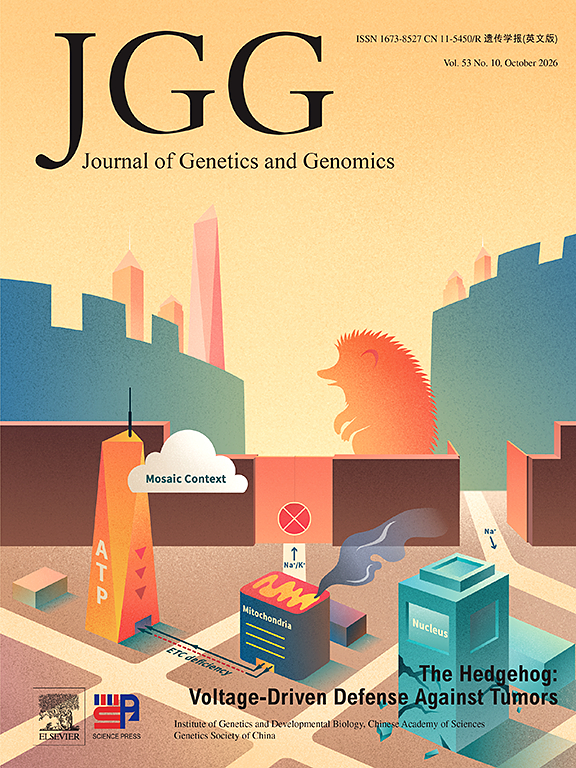
Membrane depolarization drives tumor-suppressive cell competition via hedgehog signaling activation
Kun Zhao, Dian Lv, Du Kong, Yifan Guo, Xianping Wang, Sihua Zhao, Jiadong Zheng, Jia Jing, Sha Song, Jingjie Mu, Yixin Wu, Xihui Chen, Xuan Guo, Yunpeng Huang, Wenyan Xu, Min Jiang, Xiaoqin Li, Xianjue Ma
2026, 53(10): 1860-1872. doi: 10.1016/j.jgg.2026.05.010
Abstract (224) PDF (9)
Abstract:
Tumor-suppressive cell competition (TSCC) is an evolutionarily conserved process that safeguards tissue integrity by selectively eliminating less-fit, precancerous cells. While bioelectric regulation via plasma membrane potential (Vm) is emerging as a key modulator of cellular fitness, its mechanistic role in TSCC remains underexplored. Here, we combine Drosophila genetics, single-cell RNA sequencing (scRNA-seq), and mammalian co-culture models to indicate that Vm depolarization acts as a critical driver of TSCC through Hedgehog (Hh) signaling. In Drosophila eye epithelia, scribble-deficient (scrib-/-) “loser” clones exhibit mitochondrial respiratory chain defects, leading to reduced ATP synthesis and subsequent plasma membrane depolarization. This depolarization stabilizes Smoothened at the membrane, aberrantly activating Hedgehog signaling and triggering the elimination of scrib-/- clones. Notably, we observe a striking mechanistic parallel in mammalian epithelia: Scrib-depleted Madin-Darby canine kidney cells similarly undergo Vm depolarization-dependent elimination associated with Hh pathway activation. Together, our work advances the understanding of bioelectricity in cancer surveillance and suggests that targeting membrane potential could offer a promising therapeutic strategy for cancer prevention by exploiting cell competition mechanisms.
Genetic dissection of clinical heterogeneity in hemoglobin H patients by targeted long-read sequencing
Yuhua Ye, Chao Niu, Aiping Mao, Li Chen, Lang Qin, Weijie Chen, Zhentian Liu, Tiantian Xie, Yong Long, Xuan Shang, Yushan Huang, Qianqian Zhang, Libao Chen, Hualei Luo, Yihong Li, Yulin Lu, Yumeng Liu, Liuhua Liao, Junqin Cai, Riyang Liu, Xinhua Zhang, Lihong Zeng, Yaoyun Li, Jianhong Chen, Zeyan Zhong, Jianpei Fang, Xinyu Li, Xingkun Yang, Bin Lin, Kui Li, Xiaoyun Hua, Binbin Huang, Honggui Qin, Yueyan Huang, Zhijing Huang, Jinquan Lao, Xiang Qu, Juanjuan Chen, Xiaoqin Feng, Qiujun Liu, Wanying Lin, Xiaoman Zhou, Yidan Liang, Xingjiang Long, Jiaofeng Qin, Lixiang Yan, Weijian Zhu, Lian Yu, Chengwu Fan, Deguo Tang, Tianyu Zhong, Jufang Tan, Zhilin Ren, Yang Gao, Xiangmin Xu
2026, 53(10): 1873-1883. doi: 10.1016/j.jgg.2026.04.011
Abstract (276)
Abstract:
Hemoglobin H (HbH) disease is a subtype of α-thalassemia typically caused by genetic defects in three out of four α-globin genes. To date, the genetic factors contributing to the highly heterogeneous clinical severity of HbH disease remain largely unknown. In this study, we perform targeted long-read sequencing (T-LRS) on a cohort of 591 HbH patients, aiming to profile the genomic variants and their haplotypes within the α/β-globin gene clusters and key erythroid genes. Phenotypic analysis confirms that non-deletional HbH patients generally exhibit more severe clinical manifestations compared to deletional ones. Moreover, we identify the co-inheritance of β-thalassemia mutations to be a mitigating factor for HbH patients, as reflected by higher hemoglobin levels and lower serum ferritin, suggesting the less imbalanced synthesis of α/β-globin among these patients. Furthermore, through haplotype phasing using long-sequencing reads, we find a haplotype of HS40 associated with milder clinical symptoms of HbH patients, validated by reporter gene assay, and that functional mutations in erythroid transcription factors BCL11A and HBS1L-MYB exert significant effects on β-thalassemia but not on HbH patients. This study presents the largest T-LRS study for α-thalassemia patients, which may provide insight into precise clinical diagnosis and phenotyping of HbH diseases.
TMEM63B channel is the mechanosensor in alveolar epithelial type II cells
Shi-Yu Zhan, Xiao-Yu Teng, Dan Wu, Yunfeng Zhu, Tian-Zi Zhang, Hong-Li Guo, Xiaofeng Tan, Guolin Yang, Gui-Zhou Li, Yue-Ying Wang, Bi-Xian Zhong, Gui-Fang Duan, Feng Chen, Jie Xu, Yun Stone Shi
2026, 53(10): 1884-1896. doi: 10.1016/j.jgg.2026.04.016
Abstract (292)
Abstract:
Inspiration-induced mechanical stretching serves as the primary driving force for pulmonary surfactant secretion from alveolar epithelial type II (AT2) cells. However, the mechanism by which AT2 cells sense mechanical stimuli remains elusive. Here, we demonstrate that TMEM63B functions as a critical mechanosensor on the plasma membrane of AT2 cells. We find that stretch induces significant currents in AT2 cells. Using Tmem63bHA-fl/HA-fl mice, we show that TMEM63B is expressed on the plasma membrane of AT2 cells. Deletion of TMEM63B in AT2 cells abolishes the stretch-induced currents and suppresses the secretion of pulmonary surfactant. Activation of TMEM63B causes Ca2+ influx, lamellar body (LB) fusion, and pulmonary surfactant secretion. These processes are markedly impaired upon TMEM63B deletion. In contrast, ATP-induced Ca2+ influx and LB fusion are unaffected by TMEM63B deletion, indicating that TMEM63B plays a specialized role in sensing mechanical stretch in the lungs. Therefore, our study establishes TMEM63B as a key mechanosensor critical for AT2 cell-mediated pulmonary surfactant secretion.
ZFP560 facilitates KAP1-dependent chromatin repression to regulate exit from totipotency
Qingsheng Han, Lichao Wang, Chang Liu, Huaxin Yu, Hao Zhou, Min Wei, Zongjin Li, Na Liu
2026, 53(10): 1897-1912. doi: 10.1016/j.jgg.2026.04.022
Abstract (206)
Abstract:
KRAB zinc finger proteins (KRAB-ZFPs) are the most abundant transcriptional regulators and epigenetic repressors in mammals and contribute to the silencing of transposable elements (TEs) during embryonic development. However, the early effectors of the KRAB-ZFP family during embryonic development and cell state transition remain largely unexplored. Here, we identify that zinc finger protein 560 (ZFP560) is involved in the regulation of early embryonic development and the transition from totipotency in mice. ZFP560 safeguards heterochromatin structure by recruiting KAP1 to facilitate the exit of totipotency. The deficiency of ZFP560 disrupted heterochromatin formation, significantly halting the transition from totipotency to pluripotency. Similarly, the overexpression of ZFP560 promotes exit from the MERVL-positive state and suppresses expression of 2-cell (2C) transcription factors by recruiting KAP1 via its KRAB domain, thereby reducing chromatin accessibility. Taken together, these findings reveal that ZFP560 is a highly expressed 2C-specific KRAB-ZFP transcription factor and a mediator that facilitates the exit from totipotency, providing insights into the epigenetic regulation of early embryonic development.
m6A hypomethylation assembles a fibrogenic TCF7L2-Smad2/3 complex in pterygium
Xin Zhang, Yue Li, Xiaoyan Zhang, Chuanxi Yang, Yaping Jiang, Li Chen, Ming Xu, Yihui Chen
2026, 53(10): 1913-1926. doi: 10.1016/j.jgg.2026.04.026
Abstract (196) PDF (0)
Abstract:
Pterygium progression is driven by conjunctival fibroblast fibrosis, where TGF-β and Wnt signaling pathways promote fibrotic processes. However, the crosstalk between these pathways and the underlying epitranscriptomic mechanisms remains poorly understood. In this study, we identify a TCF7L2-Smad2/3 transcriptional complex that mediates key cellular and pathogenic events in pterygium. UV radiation or inflammatory stimuli suppress METTL3 expression in human conjunctival fibroblasts. METTL3 deficiency reduces N6-methyladenosine (m6A) enrichment on TCF7L2, Smad2, and Smad3 transcripts, impairing YTHDF2-mediated recognition and degradation, leading to their abnormal stabilization and subsequent protein accumulation. Elevated TCF7L2 levels partners with Smad2/3 to form a transcriptional complex that promotes the FN1 and COL1A1 transcription, thereby contributing to extracellular matrix deposition. Exogenous modulation of METTL3 expression either mimics or reverses the TGF-β1-induced fibrotic phenotypes both in vitro and in vivo. Our findings reveal a mechanism through which environmental factors influence pterygium progression by modulating the formation of fibrotic transcriptional complexes via epitranscriptomic regulation. These insights offer potential avenues for treating fibrosis by targeting the epitranscriptome or specific transcriptional complexes.
The heterogeneity and sexual-dimorphism of human TCRαβ+CD4-CD8- double negative T cells
Dan Tian, Fengcui Qian, Lehan Pan, Mingxue Yin, Bihan Liu, Yuxi Zhang, Xiaobao Yang, Lu Yang, Guangyong Sun, Zhongtao Zhang, Songlin Wang, Patrick SC. Leung, M. Eric Gershwin, Chunquan Li, Dong Zhang
2026, 53(10): 1927-1940. doi: 10.1016/j.jgg.2026.04.008
Abstract (193) PDF (12)
Abstract:
TCRαβ+ double negative T (DNT) cells are increasingly being recognized for their critical roles in the progression of various diseases. However, the molecular and functional signatures remain poorly understood and controversial. In this study, we characterize the single-cell transcriptome, TCR repertoire, and chromatin accessibility of peripheral DNT cells from ten healthy donors. Naïve, regulatory, cytotoxic, antibody-dependent cell-mediated cytotoxicity, and helper-like DNT cell subsets exhibit specific gene expression, transcriptome regulation, development signature, and sexual heterogeneity, respectively. Using publicly available data, we observe changes in the proportion and gene expression of DNT cell subsets, especially the helper subset, in patients with ulcerative colitis and type 1 diabetes. Overall, human DNT cells exhibit phenotypic and functional diversity, providing a valuable framework for understanding the development and progression of immune-related diseases.
Single-cell multiomics gene regulatory landscape reveals impaired spermatogonial stem cells and macrophage-driven inflammaging during testicular aging
Nanhe Lin, Zhiqiang Zhang, Xianshen Sha, Jiahui Yao, Xiangzhou Sun, Rui Sun, Jiajia Yang, Qiuhua Yu, Zhengfeng Wu, Jianfeng Guan, Chengqiang Mo, Bin Ouyang, Yun Xie
2026, 53(10): 1941-1958. doi: 10.1016/j.jgg.2026.05.005
Abstract (303)
Abstract:
Testicular aging is a key driver of declining male reproductive health, but a comprehensive understanding of its underlying epigenetic drivers is lacking. To address this, we construct a multiomics aging atlas by integrating single-cell RNA sequencing, single-cell assay for transposase-accessible chromatin sequencing (scATAC-seq), and spatial transcriptomics of young and aged mouse testes. Our analysis reveals that altered chromatin accessibility accompanies transcriptional dysregulation and identifies spermatogonial stem cells (SSCs) as the most epigenetically vulnerable population. We further pinpoint ZFX as a consistently downregulated transcription factor in early germ cells, linking its decline to compromised SSC maintenance. In the somatic niche, we define disrupted regulatory networks that underpin impaired blood-testis barrier integrity in Sertoli cells and steroidogenic dysfunction in Leydig cells. Notably, we uncover an aberrant expansion of CD206+H2-Eb1- macrophages that propagates local inflammation via the secreted factor CXCL13, which we demonstrate is sufficient to disrupt the SSC niche. Cross-species analysis identifies conserved aging-associated regulons, including BRCA1 and E2F1. This work provides resources for understanding testicular senescence and nominates ZFX and CXCL13 as potential therapeutic targets for mitigating age-related reproductive decline.
Identification and functional characterization of STG5.2 conferring salt tolerance in rice
Jie Ma, Yilin Li, Hongshuang Jiang, Qiang Xu, Shaomin Shi, Xueke Chen, Zhipeng Zhang, Danlin Huang, Ying Wang, Huiying He, Chongke Zheng, Lianguang Shang, Xianzhi Xie, Jingguang Chen, Hua Wei
2026, 53(10): 1959-1970. doi: 10.1016/j.jgg.2026.04.001
Abstract (258)
Abstract:
Saline-alkaline stress severely constrains rice productivity, posing a critical threat to global food security. Identifying uncharacterized salt-tolerance genes with agronomic value is therefore essential for breeding stress-resilient and high-yield rice varieties. In this study, we identify a previously unidentified gene, LOC_Os05g07260, by combining genome-wide association studies and expression quantitative trait locus mapping, and designate it as Salt Tolerance Gene 5.2 (STG5.2), which encodes a phosphatidylinositol glycan-related protein. Functional validation reveals that STG5.2 acts as a positive regulator of both salt stress tolerance and yield-related traits in rice. STG5.2 may reprogram metabolic pathways and regulate the expression of salt-responsive genes including Na+ exclusion-related Salt Overly Sensitive 1 (OsSOS1), High-Affinity K+ Transporter 2;1 (OsHKT2;1), and stress tolerance-positive regulator Acireductone Dioxygenase 1 (OsARD1), forming a multi-layered regulatory network for salt adaptation. Combined with phenotypic data from chromosome segment substitution lines, the superior STG5.2 haplotype, predominantly present in indica rice, shows great potential for improving salt tolerance in japonica backgrounds. Overall, our results highlight that STG5.2 may modulate rice salinity resilience by regulating ion homeostasis and the coordination of multiple stress-responsive pathways, providing a potential molecular basis for breeding salt-tolerant rice varieties.
OsMDS1 regulates cell elongation and thermotolerance in rice
Menghan Fan, Junfeng Dai, Zhigang Wu, Yong Yang, Lisha Zhang
2026, 53(10): 1971-1983. doi: 10.1016/j.jgg.2026.04.006
Abstract (219) PDF (9)
Abstract:
Cereal crops often exhibit a tradeoff between thermotolerance, which is important for climate adaptation, and cell elongation, which is crucial for ideal plant architecture and yield. Here, we characterize the rice mutant with dwarfing and short roots/grains 1 (Osmds1), which shows dwarfism, short roots, and reduced grain size, along with enhanced thermosensitivity. OsMDS1 encodes a KNOTTED1-like homeobox (KNOX) transcription factor. A 15-bp deletion in the GSE domain of OsMDS1 is identified in Osmds1, which we show to be an allele of Osh15, d6, Oskn3, Shennong9816d, and rlb. OsMDS1 interacts with the chaperone LO9-177 and the transcription factor OsBC1, two components of the OsBUL1-LO9-177-OsBC1 complex, but not with OsBUL1, whereas Osmds1 binds to all three components. Further analysis indicates that OsMDS1 and OsBC1 synergistically activate the auxin biosynthesis genes OsYUCCA1 and OsTDD1, revealing a link between the KNOX and auxin pathways. OsMDS1 also interacts with the heat-shock protein OsDjC38 and regulates its expression. Genetic analysis shows that Osmds1 and OsDjC38 knockout plants have elevated sensitivity to prolonged heat stress and impaired antioxidant enzyme activity. Our results suggest that OsMDS1 coordinates both cell elongation and the heat-stress response, possibly through auxin pathways, providing a promising target for rice breeding.

ZmFBL41 variants enhance maize resistance to Rhizoctonia solani by attenuating ZmFAH degradation and increasing fumaric acid accumulation
Jicheng Qu, Bao Lin, Tiantian Geng, Mingyue Lai, Yunya Bi, Fangyu Liang, Bin Yuan, Daolin Fu, Jiajie Wu, Haifeng Liu, Zhaohui Chu
2026, 53(10): 1984-1997. doi: 10.1016/j.jgg.2026.04.009
Abstract (261)
Abstract:
The F-box protein ZmFBL41, which targets ZmCAD and ZmNCED6, increases susceptibility to maize banded leaf and sheath blight (BLSB). Here, we report significantly reduced BLSB resistance in maize expressing the susceptible haplotype ZmFBL41B73, and the identification of ZmFBL41B73-interacting protein, fumarylacetoacetate hydrolase (FAH). In contrast to ZmCAD, which interacts with the LRR3 motif, ZmFAH interacts with each LRR motif of ZmFBL41B73. ZmFAH positively regulates plant resistance to Rhizoctonia solani and decrease BLSB resistance in zmfah maize but increase sheath blight (ShB) resistance in ZmFAH-overexpressing rice. ZmFAH is involved in fumaric acid (FA) metabolism, which inhibits fungal growth and invasion in plants. Compared with the susceptible allele of ZmFBL41B73, the resistant haplotype ZmFBL41Chang7-2, with two amino acid substitutions, exhibits weaker interactions with and attenuates the degradation of ZmFAH, thereby resulting in greater FA accumulation and increased resistance to BLSB in the inbred lines of the Chang7-2 haplotype than in those of the B73 haplotype. Additionally, field fumarate pretreatment significantly increases rice resistance to bacterial blight and ShB. Collectively, our findings reveal the dual functions of ZmFBL41Chang7-2 in strengthening the host's chemical barrier through FA accumulation in addition to the previously identified physical barrier protection through lignin accumulation during fungal infection.
Fusing T7 exonuclease with the G-to-T base editor enhances the editing purity in rice
Qiurong Ren, Xiaojuan Gao, Tao Shi, Jiangmei Cao
2026, 53(10): 1998-2007. doi: 10.1016/j.jgg.2026.04.010
Abstract (207)
Abstract:
The G-to-T base editor (GTBE) is a genome editing tool that does not rely on deaminases. However, its application has been limited by low G-to-T editing efficiency and high insertion and deletion (InDel) byproduct rates. In this study, we develop a series of editors (GTBE1-GTBE7) using three strategies: modification of the Cas9 nickase (nCas9) variant, fusion with a transcriptional activation domain, and fusion with a 5'-3' exonuclease targeting nicked DNA. Both protoplast and stable rice transformant analyses reveal that the GTBE7 editor, which incorporates T7 exonuclease, significantly improves G-to-T editing purity compared with the previously reported GTBE1 editor. In stable transformants, the InDel efficiency of GTBE7 is reduced by 14%-27.7% compared with GTBE1. To further broaden the editing range of GTBE7, we develop the GTBE7_nSpRY editor, enabling G-to-T base editing at non-NGG protospacer adjacent motif (PAM) sequences. Using GTBE7_nSpRY, we create herbicide-resistant rice and identify the G628A mutation site, generating imazethapyr-resistant rice plants through G-to-C byproduct edits. In summary, the GTBE7 and GTBE7_nSpRY editors developed in this study enhance G-to-T editing purity, reduce InDel byproduct efficiency, and offer potential for expanding the application of G-to-T base editing in plants.
Population genomics reveals selection signatures and favorable haplotypes for low chalkiness in indica rice
Risheng Li, Yamei Ma, Shuai Nie, Jingbo Zhou, Yunmeng Cao, Ke Zheng, Hui Wang, Tifeng Yang, Jingfang Dong, Jiansong Chen, Jian Wang, Lian Zhou, Lei Zhao, Shaochuan Zhou, Chongrong Wang, Junliang Zhao, Ziqiang Liu, Haifei Hu
2026, 53(10): 2008-2021. doi: 10.1016/j.jgg.2026.04.013
Abstract (315)
Abstract:
Grain chalkiness compromises rice appearance quality and market value. The genetic basis of chalkiness reduction in indica rice remains less well understood than that in japonica. Modern Guangdong indica varieties released since the 1980s have long, translucent grains with low chalkiness, making them a suitable system to dissect quality improvement in indica. Here, we analyse whole-genome variation in 154 Guangdong indica varieties and 229 genetically diverse international indica accessions. Integrating population genomics, haplotype association analysis, and endosperm expression profiling, we identify four major chalkiness-associated genes, Wx, Chalk5, OsDER1, and OsATG8b, showing strong genetic differentiation consistent with breeding selection in Guangdong germplasm. Superior haplotypes at all four loci are significantly associated with reduced chalkiness in multi-year phenotyping in Guangzhou and in independent trials from the Philippines. Analysis of the HuangHuaZhan pedigree further reveals stepwise pyramiding and fixation of these haplotypes during grain-quality improvement. Across other indica-growing provinces in southern China, favorable haplotypes at Wx and OsDER1 are largely fixed in cultivated varieties, whereas those at Chalk5 and OsATG8b remain less deployed. Variants in these four genes also enable efficient prediction of chalkiness across multiple machine learning models. Together, these results illustrate how breeding enriched favorable haplotypes for low chalkiness in indica rice.
Decoding chromosome organization using proximity labeling and long-read sequencing
Kewei Xu, Yichen Zhang, James Baldwin-Brown, Thomas A. Sasani, Nitin Phadnis, Matthew P. Miller, Ofer Rog
2026, 53(10): 2022-2033. doi: 10.1016/j.jgg.2026.05.004
Abstract (174) PDF (3)
Abstract:
Genomic approaches have provided detailed insight into DNA-protein interactions and chromosome architecture. However, commonly deployed techniques do not preserve connectivity-based information, leaving large-scale genome organization poorly characterized. Here, we develop npDamID, an in vivo proximity-labeling technique that indelibly marks and then decodes protein-associated sites. npDamID tethers dam methyltransferase to a protein of interest, followed by Nanopore sequencing to identify methylated bases along reads >100 kb. As proof-of-concept, we analyze, in budding yeast, a conserved cohesin-based meiotic backbone that organizes chromatin into an array of loops. Our data recapitulate the pertinent features of known cohesin association patterns and, importantly, expose variability between cells. Analysis of single reads reveals distance-dependent short- and long-range correlation between adjacent methylated bases. Finally, an important advantage of our approach is the ability to define protein association patterns in repetitive regions. By anchoring ultra-long reads onto unique regions, we define in vivo cohesin association patterns within the ribosomal DNA locus. Our versatile technique promises to illuminate diverse chromosomal processes by providing a cumulative record of heterogeneous association patterns of chromosomal factors as well as the in vivo conformations of single chromosomes.
Research Communications
Comparative genomics reveals lineage-specific accelerated evolution and functional convergence in pigs
Mingfang Zhou, Ruirong Liu, Mingpeng Zhang, Huashui Ai
2026, 53(10): 2034-2037. doi: 10.1016/j.jgg.2026.04.014
Abstract (354)
Abstract:
SZDB3.0: an updated comprehensive resource and web tools for schizophrenia research
Changgai Mu, Xinglun Dang, Shan-Shan Dai, Wenqi Lou, Yong Wu, Yong-Gang Yao, Wenqiang Li, Xiong-Jian Luo
2026, 53(10): 2038-2041. doi: 10.1016/j.jgg.2026.04.025
Abstract (480)
Abstract:
Haplotype-resolved T2T genome assembly of wild Cannabis provides molecular insights into drought tolerance
Yuan Zhang, Mengbi Guo, Xuejing Zi, Yanping Xu, Pin Lv, Yuan Li, Qingying Zhang, Ming Yang, Yaolong Zhang, Riaz Muhammad Khan, Xuan Chen
2026, 53(10): 2042-2045. doi: 10.1016/j.jgg.2026.04.020
Abstract (551)
Abstract:
A near-complete T2T genome assembly reveals a depleted immune repertoire as the genetic cause of endangerment in Carya poilanei
Yuke Zhou, Jinchen Ye, Yingshan Chen, Ruifeng Yang, Jiahong Hong, Xiyang Ye, Junyan Hu, Guohua Xia, Chuanmei Xu, Youjun Huang
2026, 53(10): 2046-2049. doi: 10.1016/j.jgg.2026.04.002
Abstract (459)
Abstract:
FAK activation drives non-genetic adaptive survival of ALK-rearranged lung cancer under tyrosine kinase inhibitor treatment
Xinru Chen, Jinhui Xue, Lin Zhang, Jie Huang, Songran Liu, Xinxin Zhang, Fan Wang, Yihua Huang, Jiani Zheng, Zhonghan Zhang, Yunpeng Yang, Hongyun Zhao, Jia-Xing Yue, Li Zhang, Jing Li
2026, 53(10): 2050-2053. doi: 10.1016/j.jgg.2026.04.023
Abstract (243)
Abstract:
simple-article
Corrigendum to “RASSF6-TRIM16 axis promotes cell proliferation, migration and invasion in esophageal squamous cell carcinoma” [J. Genet. Genom. (2019) 46, 477-488]
Leilei Zheng, Zitong Zhao, Lulu Rong, Liyan Xue, Yongmei Song
2026, 53(10): 2054-2058. doi: 10.1016/j.jgg.2026.08.003
Abstract (133) PDF (0)
Abstract: