9.9
CiteScore
7.1
Impact Factor

Current Issue

2026 Vol. 53, No. 3

Display Method:
Review
To see and to know: the power of live imaging in illuminating and decoding biological complexity
Miaoling Yang, Zhuo Du
2026, 53(3): 361-380. doi: 10.1016/j.jgg.2025.10.003
Abstract (0) PDF (0)
Abstract:
Live imaging enables direct observation of dynamic biological processes, capturing their progression from molecular to organismal scales in space and time. Through high-resolution observation, it provides a powerful means to decode biological complexity by revealing dynamic behaviors, spatial patterns, and regulatory changes. This review illustrates the application of live imaging in investigating complex biological processes with spatiotemporal resolution and mechanistic insight. We first highlight the analytical power and integrative strategies of live imaging, and then summarize recent advances that further extend its capacities. We then focus on four complex processes—cell proliferation, lineage regulation, morphogenesis, and atlas construction—to elucidate how live imaging contributes to their decoding through representative studies. We also discuss the conceptual and practical limitations that currently constrain the full interpretive potential of live imaging, underscoring the need for deeper integration between observation, perturbation, and modeling. Looking ahead, live imaging will benefit from both technical refinement and advances in data standardization and visualization, functional quantification, multiscale integration, and the discovery of generalizable principles. Together, these directions advance a more integrative and mechanistic understanding of complex biological processes.
Genetic innovations underlying the evolution of root nodule symbiosis in Leguminosae
Tengfei Liu, Hao Lin, Zhixi Tian
2026, 53(3): 381-388. doi: 10.1016/j.jgg.2025.09.008
Abstract (19) PDF (1)
Abstract:
Root nodule symbiosis (RNS) is a mutualistic association formed between nitrogen-fixing rhizobia or Frankia and host plants limited to four orders within Rosid I—Fabales, Fagales, Cucurbitales, and Rosales—which comprise the so-called ‘Nitrogen Fixing Nodulation Clade’ (NFNC). The majority of nodulation studies have focused on Leguminosae, given their agricultural and environmental importance, as well as the widespread occurrence of nodulation among members of this family. Endowing cereal crops with nitrogen fixation, like Leguminosae, presents a strategy to reduce the detrimental effects of synthetic fertilizer overuse. Different hypotheses on the origin of RNS have been proposed; however, key genetic innovations underlying the evolution of RNS, even in Leguminosae, have been rarely reported. In this review, we begin by examining current knowledge of genetic innovations—including gene gain, gene loss, and the acquisition or loss of conserved noncoding sequences (CNS) in preexisting genes. We explore the available evidence supporting these genetic innovations underlying the evolution of RNS in Leguminosae and offer the phylogenomics approach that could be applied to uncover these genetic innovations. Finally, we conclude by proposing a model of genetic innovations underlying the evolution of RNS in Leguminosae and consider the potential implications for the development of nitrogen-fixing crops.
Original Research
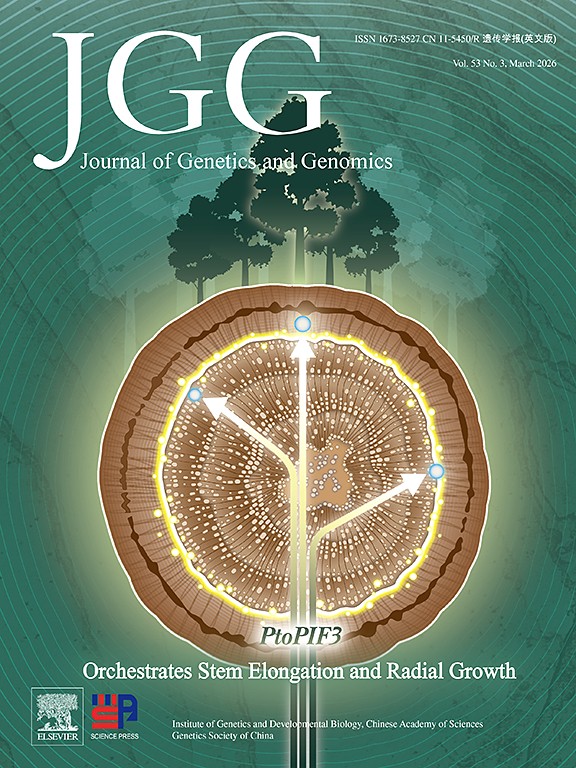
Phytochrome-interacting factor3 (PIF3) orthologs orchestrate stem elongation and wood formation in Populus
Xingyue Xiao, Hongli Cheng, Jianghai Mo, Fan Sun, Qin Song, Chengshan Zhang, Pan Yang, Keming Luo, Hongbin Wei
2026, 53(3): 389-400. doi: 10.1016/j.jgg.2025.07.002
Abstract:
Phytochrome-interacting factors (PIFs) have been established as negative regulators of vascular patterning and xylem differentiation in the herbaceous plant Arabidopsis thaliana, however, the regulatory role of PIFs in secondary growth in woody species remains unclear. Here, we examines the expression patterns and involvement of PtoPIF3.1 and PtoPIF3.2 during stem growth and secondary xylem development in Populus tomentosa. Overexpression of either PtoPIF3.1 or PtoPIF3.2 significantly enhances both longitudinal stem growth and radial wood development. Conversely, Ptopif3.1 and Ptopif3.2 mutants generated by CRISPR-mediated genome editing exhibit reciprocal phenotypic defects. Exogenous auxin application partially restores the phenotypes of Ptopif3.1 and Ptopif3.2 mutants, and the auxin biosynthesis-deficient mutant Ptoyuc8 exhibits developmental abnormalities similar to those observed in Ptopif3 mutants. Further analysis reveal that PtoPIF3s directly bind to and activate expression of PtoYUC8 and cell expansion-related genes PtoEXPA1.1/1.2, while modulating cambial division and expression of secondary xylem development marker genes (PtoWOX4, PtoANT, PtoCYCD3s, and PtoHB7/8) through auxin-mediated signaling. Together, our findings establish PtoPIF3.1/3.2 as key regulators that coordinate stem elongation and secondary growth in Populus, highlighting the functional divergence of PIF homologs between herbaceous and woody species.
Estimating genetic load from 5000 Chinese exomes
Xiaoyue Du, Xiaoxi Zhang, Jiucun Wang, Li Jin, Shuhua Xu
2026, 53(3): 401-413. doi: 10.1016/j.jgg.2025.08.009
Abstract (0) PDF (0)
Abstract:
Recent advancements in genome sequencing have enabled the estimation of genetic load through deleterious mutation profiling. However, Chinese populations remain underexplored in this context. We analyze whole-exome sequencing data from 5002 individuals, encompassing major Han subgroups—North Han (N-Han), South Han (S-Han), and Guangxi Han (G-Han)—as well as 13 ethnic minorities. Notably, G-Han exhibits significant genetic affinity with the Zhuang population. Systematic curation of 2110 ClinVar pathogenic or likely pathogenic variants reveals 93.4% are ultra-rare. Exceptions include GJB2 rs72474224-A (hearing loss), which shows higher frequencies in Zhuang and G-Han, and β-thalassemia-associated HBB variants (rs33986703-A and rs33950507-T), which are elevated in G-Han compared to other Han subgroups. Among 96 autosomal dominant mutation carriers, LDLR variants are predominant (∼25%), with comparable frequencies across Han subgroups. Adaptive signatures highlight gene-environment interactions: MTHFR rs1801133-A (UV adaptation) declines southward, while ALDH2 rs671-A (alcohol metabolism) displays the opposite trend. ABCC11 rs17822931-A, associated with cold adaptation, is particularly low frequency in G-Han. Gene-based rare-variant collapsing analyses identify an elevated risk of retinitis pigmentosa in S-Han (PRPF4, TUB). Our findings demonstrate that genetic load in Chinese populations is influenced by demographic history, population structure, and regional adaptation, emphasizing the importance of population-specific frameworks in precision medicine.

Genomic insights into population structure, adaptation, and archaic introgression at the Himalayan–East Asian crossroads
Mengge Wang, Shuhan Duan, Qiuxia Sun, Yuntao Sun, Lintao Luo, Yunhui Liu, Renkuan Tang, Libing Yun, Chao Liu, Guanglin He
2026, 53(3): 414-432. doi: 10.1016/j.jgg.2025.09.010
Abstract (11) PDF (0)
Abstract:
Tibetan-Yi Corridor (TYC) is a crucial agro-pastoral region in the eastern Himalayas, linking Qinghai‒Xizang Plateau with the lowlands of East Asia and facilitating human migration for millennia. However, genomic research on TYC populations remains limited, which limits the understanding of their origins and health. We provide genomic data from 1031 individuals belonging to Austroasiatic and Sino-Tibetan groups, including 147 whole-genome sequences from 13 underrepresented Tibeto-Burman and Austroasiatic communities. Our analysis reveals approximately 3.3 million new genetic variants and 4 distinct genetic backgrounds within TYC populations. Demographic reconstructions reveal strong genetic connections among Tibeto-Burman groups, Central Plain Sinitic populations, and Yangshao farmers, supporting a common origin for Sino-Tibetan speakers. We identify signatures of high-altitude adaptations typical of Tibetans and TYC-specific variants linked to pigmentation and hypoxia responses. Differentiation involves mechanisms such as HLA-DQB1, which are related to immune function. Several rare pathogenic variants, like CYP21A2 and PRX, are notably frequent. Variants influencing warfarin sensitivity show significant variation. Archaic human introgression further promotes genomic complexity, impacting cardiovascular and immune-related genes, which suggests adaptation through ancient human interactions. These findings refine the evolutionary history of TYC populations and underscore the need for broader genomic research to capture regional diversity and inform precision medicine.
Genome of aerial alga Trentepohlia odorata reveals insights into the evolution of terrestrial lifestyle in green algae
Yuanhao Li, Jiao Fang, Xiaoya Ma, Hao Wang, Shiyu Zhang, Yu Peng, Lin Chen, Guoxiang Liu, Huan Zhu, Zhenhua Zhang, Bojian Zhong
2026, 53(3): 433-446. doi: 10.1016/j.jgg.2025.09.004
Abstract:
Trentepohliales is a completely terrestrial order within Ulvophyceae (the core Chlorophyta), and its closely related lineages are mainly marine macroalgae (green seaweeds). Despite the considerable interest in their biotechnological potential, little is known about their adaptations to challenging terrestrial habitats. Here, we assemble the high-quality reference genome of Trentepohlia odorata. This alga shows duplications of key genes associated with lipid metabolism and carotenoid synthesis, potentially facilitating intracellular accumulation of lipid droplets and carotenoids. We further reveal positive selection and expansion of gene families involved in vesicle trafficking and cell division regulation in T. odorata compared with other algae (cleavage furrow-mediated cell division) in Ulvophyceae, providing a genetic foundation for the evolution of phragmoplast-mediated cell division. The combined C4-like and biophysical CO2-concentrating mechanisms (CCMs) of T. odorata enable adaptation to fluctuating CO2 environments, and support efficient photosynthesis under CO2-limited conditions. Adaptive strategies of T. odorata to terrestrial stressors, such as drought, intense light, and UV-B radiation, include horizontally acquired genes involved in cell wall synthesis and remodeling, homeostasis of aldehydes, and expanded genes associated with reactive oxygen species (ROS), DNA repair, and photoprotection. Our study provides a valuable genomic resource for studying aerial algae and improves understanding of plant terrestrialization.
Integrative multi-omics and genomic prediction reveal genetic basis of salt tolerance in alfalfa
Fei He, Ming Xu, Ruicai Long, Kai Zhu, Mengrui Du, Wenqi Ma, Hui Xue, Yanling Peng, Lin Chen, Junmei Kang, Yongfeng Zhou, Qingchuan Yang, Fan Zhang
2026, 53(3): 447-457. doi: 10.1016/j.jgg.2025.09.001
Abstract:
The genetic basis of early-stage salt tolerance in alfalfa (Medicago sativa L.), a key factor limiting its productivity, remains poorly understood. To dissect this complex trait, we integrate genome-wide association studies (GWAS) and transcriptomics from 176 accessions within a machine learning based genomic prediction framework. Analysis reveals weak genetic correlations among four salt-tolerance traits and a gradual decline in performance under increasing salt stress. GWAS identify 60 significant associated SNPs, with the highest number detected under 100 mM salt stress. Salt tolerance exhibits an additive effect from favorable haplotypes, which are most abundant in Chinese accessions. GWAS-associated genes are related to key regulators of hormone signaling and osmotic adjustment, while transcriptome analysis indicates a global repression of stress-responsive transcription factors. Integrating these multi-omics datasets allows us to identify 14 candidate genes, including MsHSD1 (seed dormancy) and MsMTATP6 (energy metabolism). Crucially, incorporating these markers into genomic prediction models improve cross-population predictive accuracy to an average of 54.4%. This study provides insights into the genetic architecture of salt tolerance in alfalfa and offers valuable markers to facilitate molecular breeding.
Assembly of a high-quality reference genome and characterization of a chemical-mutagenized library of an elite soybean cultivar Tianlong 1
Yinghua Sheng, Yicheng Huang, Zilun Jin, Xuyan Wang, Chenghui Liu, Jingwen Zhang, Zhipeng Zhou, Chuang Ma, Jianwei Zhang, Min Chen
2026, 53(3): 458-466. doi: 10.1016/j.jgg.2025.08.006
Abstract:
Soybean (Glycine max L.) is a globally vital crop for oil production and food security. High-quality genomic resources are instrumental for both functional genomics and breeding. Here, we report a near-complete, high-quality genome assembly of the elite cultivar Tianlong 1 (TL1), featuring fully resolved telomeres and centromeres, as well as a gap-free assembly of 14 of its 20 chromosomes. On the basis of the genome assembly, we generate an ethyl methanesulfonate (EMS)-mutagenized population comprising 2555 M7 plants. Whole-genome resequencing of 288 EMS mutants uncovers 1,163,869 high-confidence single-nucleotide polymorphisms (SNPs) and 542,709 insertions/deletions (InDels), achieving 91.89% coverage of predicted protein-coding genes. Phenotypic screening demonstrates robust genotype–phenotype associations, with two nonsynonymous mutants displaying pronounced defects in seed and leaf development. Collectively, the chromosome-scale TL1 genome assembly and the extensively characterized mutant population establish valuable resources for functional genomics and precision breeding in soybean and related legume species.
Genomic sequencing as a key primary recommendation for neonatal hyperbilirubinemia: a population-based multicenter study
Dabin Huang, Xia Gu, Weizhong Li, Hongying Mi, Haiquan Zeng, Guiying Zhuang, Sitao Li, Congcong Shi, Tao Wei, Wei Zhou, Xin Xiao, Wenhao Zhou, Hu Hao
2026, 53(3): 467-475. doi: 10.1016/j.jgg.2025.09.002
Abstract (0) PDF (0)
Abstract:
Genetic variations are risk factors for neonatal hyperbilirubinemia (NHB), a common cause of infant hospitalization in the first postnatal week, but their contribution and long-term impacts remain unclear. This population-based multicenter study enrolls 1780 hospitalized NHB newborns and 38,158 genetically screened newborns across 20 hospitals (2019–2022). Excluding cases with clear clinical causes, 977 NHB cases are categorized into genetic variation-positive and -negative groups. Results show significantly higher NHB-related gene variants (81.63% vs. 65.62%) and positive variation rates (36.29% vs. 9.4%) in NHB cases than in the general newborn population (all P < 0.001). Among the 977 NHB cases, 325 (33.3%) have positive variants, with higher rates of severe hyperbilirubinemia (16.9% vs. 9.7%, P = 0.001), prolonged jaundice (36.3% vs. 27.6%, P = 0.005), and cholestasis/hypercholanaemia (23.7% vs. 14.7%, P < 0.001) in the positive group. Cumulative genetic variants in bilirubin metabolism pathways exhibit dose-dependent associations with increased risks of complications. Long-term follow-up reveals that UGT1A1 variants prolong jaundice up to one month, while severe SLC10A1 variants cause persistent cholestasis/hypercholanaemia beyond nine months. This large-scale evidence highlights genetic factors as key NHB determinants, with implications for neonatal care protocols to integrate genetic testing and establish long-term surveillance for variant carriers.
MitoQ alleviates m.3243A>G-induced mitochondrial dysfunction by stabilizing PINK1 and enhancing mitophagy
Baige Cao, Lei Fang, Yinan Zhang, Chuwen Lin, Peng Liu, Huina Zhang, Orion Fan, Ming Xu, Zhao Qin, Congrong Wang
2026, 53(3): 476-487. doi: 10.1016/j.jgg.2025.08.007
Abstract:
The mitochondrial 3243A>G mutation (m.3243A>G) is associated with diverse clinical phenotypes. To elucidate the underlying mechanisms and explore intervention strategies in m.3243A>G patients, urine-derived stem cells (USCs) and a mitochondrial leucyl-tRNA synthetase gene (lars-2) deficient Caenorhabditis elegans (C. elegans) model are used to assess mitochondrial homeostasis and neuromuscular dysfunction. Patient-derived USCs with high levels of m.3243A>G heteroplasmy exhibit impaired mitochondrial function, disrupted mitochondrial dynamics, and inhibited mitophagy, which are reversed by MitoQ through suppression of OMA1 zinc metallopeptidase (OMA1)-induced mitochondrial phosphatase and tensin (PTEN) induced kinase 1 (PINK1) degradation. Furthermore, lars-2 knockdown in C. elegans induces mitochondrial stress and mimics the loss of neural and muscle functions observed in patients with the m.3243A>G mutation. MitoQ treatment partially improves neurobehavioral function by promoting the PINK1 pathway. These findings suggest that MitoQ has therapeutic potential in the context of the m.3243A>G mutation.
Application of an optimized non-invasive prenatal testing for thalassemia based on change of haplotype doses
Fei Sun, Yao Zhou, Xing Zhao, Qiuling Jie, Linna Ma, Dan Lin, Yaxuan Li, Yangqing Mai, Ge Gao, Yongfang Zhang, Qi Li, Yanlin Ma
2026, 53(3): 488-496. doi: 10.1016/j.jgg.2025.09.007
Abstract (0) PDF (0)
Abstract:
Patients affected by monogenic diseases impose a substantial burden on both themselves and their families. The primary preventive measure, i.e., invasive prenatal diagnosis, carries a risk of miscarriage and cannot be performed early in pregnancy. Hence, there is a need for non-invasive prenatal testing (NIPT) for monogenic diseases. By utilizing enriched cell-free fetal DNA (cffDNA) from maternal plasma, we refine the NIPT method, which combines targeted region capture technology, haplotyping, and analysis of informative site frequency. We apply this method to 93 clinical families at genetic risk for thalassemia, encompassing various genetic variant types, to establish a workflow and evaluate its efficiency. Our approach requires only 3 ng of DNA input to generate 0.1 Gb informative target genomic data and leverages a minimum of 3% cffDNA. This method has a 98.16% success rate and 100% concordance with conventional invasive methods. Furthermore, we demonstrate the ability to analyze fetal genotypes as early as eight weeks of gestation. This study establishes an optimized NIPT method for the early detection of various thalassemia disorders during pregnancy. This technique demonstrates high accuracy and potential for clinical application in prenatal diagnosis.
Gene traffic mediated by transposable elements shaped the dynamic evolution of ancient sex chromosomes of varanid lizard
Zexian Zhu, Jason Dobry, Erik Wapstra, Qi Zhou, Tariq Ezaz
2026, 53(3): 497-509. doi: 10.1016/j.jgg.2025.08.002
Abstract:
Lizards usually exhibit frequent turnovers and a much greater diversity of sex determination mechanisms compared to birds and mammals, with the conserved ZW sex chromosomes of anguimorph lizards originating over 115 million years ago a seeming exception. We previously discovered in an anguimorph lizard Varanus acanthurus (Vac) whose entire chrW, but not chrZ is homologous to part of the chr2 by cytogenetic mapping, suggesting its complex history of sex chromosome evolution yet to be elucidated. To address this, we assemble a chromosome-level genome, and provide evidence that the Vac sex chromosome pair has undergone at least two times of recombination loss, producing a pattern of evolutionary strata like that of birds and mammals. Comparison to other lizard genomes date the stepwise propagation of specific retrotransposon subfamilies enriched near the duplicated gene pairs on the chrW and chr2 to the varanid ancestor. These retrotransposons probably have mediated the recruitment and amplification of autosomal genes on the chrW, including members of a large vomeronasal chemosensory receptor gene family V2R. Our results suggest that the W or Y chromosome as a refugium of repetitive elements, may recurrently recruit short-lived functional genes responsible for sexual dimorphisms during its long-term course of degeneration.
circRNAs derived from a nuclear hormone receptor act differentially on insect metamorphosis and reproduction
Lulu Gao, Qiang Yan, Ying Qu, Wanwan Li, Jiasheng Song, Shutang Zhou
2026, 53(3): 510-521. doi: 10.1016/j.jgg.2025.10.001
Abstract:
Insects are the most diverse group on earth, partially owing to their metamorphosis and strong fecundity. Circular RNAs (circRNAs) are stable molecules implicated in a broad range of biological processes. However, the regulatory roles of circRNAs in insect metamorphosis and reproduction are unclear. Methoprene-tolerant (Met) is the nuclear receptor of juvenile hormone (JH) that plays dual roles, inhibiting precocious metamorphosis and promoting reproduction. Here, we report that locust Met generates two circRNAs, circMet1 and circMet2, respectively. While circMet1 is highly expressed in the cuticle of late final instar, circMet2 is more abundant in the corpora allata, brain, and fat body of early vitellogenic adults. Interestingly, circMet2 is generated by complementary pairing of Penelope-like remnants across the introns of Met. Moreover, circMet2 functions as a miRNA sponge of four species-specific miRNAs that downregulate Met translation. siRNA-mediated knockdown of circMet1 causes the delay of metamorphosis and retarded vitellogenesis. Loss of circMet2 results in significantly decreased vitellogenin synthesis, along with blocked ovarian growth. These results reveal the differential roles of circMet1 and circMet2 in modulating insect metamorphosis and female reproduction. This study advances our understanding of how circRNAs derived from a single gene exert distinct roles in insect life history.
Single-molecule chromatin profiling reveals cell type-specific A/B compartment alteration and multi-enhancer transcriptional coordination
Luo-Ran Liu, Jia-Yong Zhong, Xin Bai, Chen-Liang Ye, Chunhui Hou, Junjun Ding, Wei Chi, Chuan-Le Xiao, Longjian Niu
2026, 53(3): 522-536. doi: 10.1016/j.jgg.2025.09.011
Abstract (11) PDF (1)
Abstract:
In eukaryotic organisms, the three-dimensional organization and epigenomic landscape of chromatin are fundamental to the regulation of gene expression. Previous studies have provided significant insights into CpG methylation, chromatin accessibility, and the dynamics of 3D architecture. However, a systematic delineation of how these epigenomic features regulate transcriptional activity remains limited. In this study, we develop nanoCAM-seq, a single-molecule sequencing technique designed to simultaneously profile higher-order chromatin interactions, chromatin accessibility, and endogenous CpG methylation. This approach provides an integrative view of chromatin features associated with cis-regulatory elements and reveals their coordinated dynamics during transitions of A/B compartments. Single-molecule analyses using nanoCAM-seq further reveal that promoters characterized by low CpG methylation and high chromatin accessibility more frequently interact with multiple enhancers. Collectively, our findings establish nanoCAM-seq as a powerful approach for resolving the coordinated dynamics of chromatin architecture and epigenetic modifications, offering critical insights into the regulatory mechanisms underlying gene expression.
tsRNADisease: a manually curated database of tsRNAs associated with human disease
Hui Yang, Shaoying Zhu, Huijun Wei, Wei Huang, Qi Chen, Yungang He, Kun Lv, Zhen Yang
2026, 53(3): 537-543. doi: 10.1016/j.jgg.2025.08.001
Abstract (10) PDF (0)
Abstract:
tRNA-derived small RNAs (tsRNAs), as a class of regulatory small noncoding RNA, have been implicated in a wide variety of human diseases. Large amounts of tsRNA–disease associations have been identified in recent years from accumulating studies. However, repositories for cataloging the detailed information on tsRNA–disease associations are scarce. In this study, we provide a tsRNADisease database by integrating experimentally and computationally supported tsRNA–disease associations from manual curation of literatures and other related resources. tsRNADisease contains 5571 manually curated associations between 4759 tsRNAs and 166 diseases with experimental evidence from 346 studies. In addition, it also contains 5013 predicted associations between 1297 tsRNAs and 111 diseases. tsRNADisease provides a user-friendly interface to browse, retrieve, and download data conveniently. This database can improve our understanding of tsRNA deregulation in diseases and serve as a valuable resource for investigating the mechanism of disease-related tsRNAs. tsRNADisease is freely available at http://www.compgenelab.info/tsRNADisease.
Research Communications
Dissecting the genetic basis of reproductive transition and reproductive growth in wheat by considering accumulated temperature
Liujie Jin, Kening Duo, Chao Fu, Yunzhen Li, Chao He, Xin Gong, Wenhao Yan
2026, 53(3): 544-546. doi: 10.1016/j.jgg.2025.09.012
Abstract:
E75-induced Toll/NF-κB signaling cooperates with Notch and Hippo pathways to promote tumor malignancy
Xianping Wang, Yifan Guo, Chenglong Wang, Jingjie Mu, Xianjue Ma
2026, 53(3): 547-550. doi: 10.1016/j.jgg.2025.10.006
Abstract:
Complete genome assembly of the Xian rice variety IR64 as a valuable source in genomics and breeding research
Min Li, Tingting Sheng, Linjun Yu, Shuyue Zheng, Shijiao Li, Shuran Zhou, Fengcai Wu, Fan Zhang, Chaopu Zhang, Erbao Liu, Yingyao Shi, Xue Mi, Xueru Zhang, Zhikang Li, Yanru Cui, Wensheng Wang
2026, 53(3): 551-554. doi: 10.1016/j.jgg.2025.11.010
Abstract: